TIPE research project — Inductive charging on the move
WattWay — inductive road
Exploring the feasibility of inductive charging while driving: studying the critical parameters, improving energy transfer, then validating on a test “road”.
- Setting
- TIPE — CPGE PSI
- Fields
- Electromagnetism, power electronics
- Approach
- Measurement, optimisation, prototype
- Deliverable
- Test road + charging chain
Context & problem
The project focuses on energy conversion and on reducing the charging constraints of electric vehicles: charging stops, range, infrastructure.
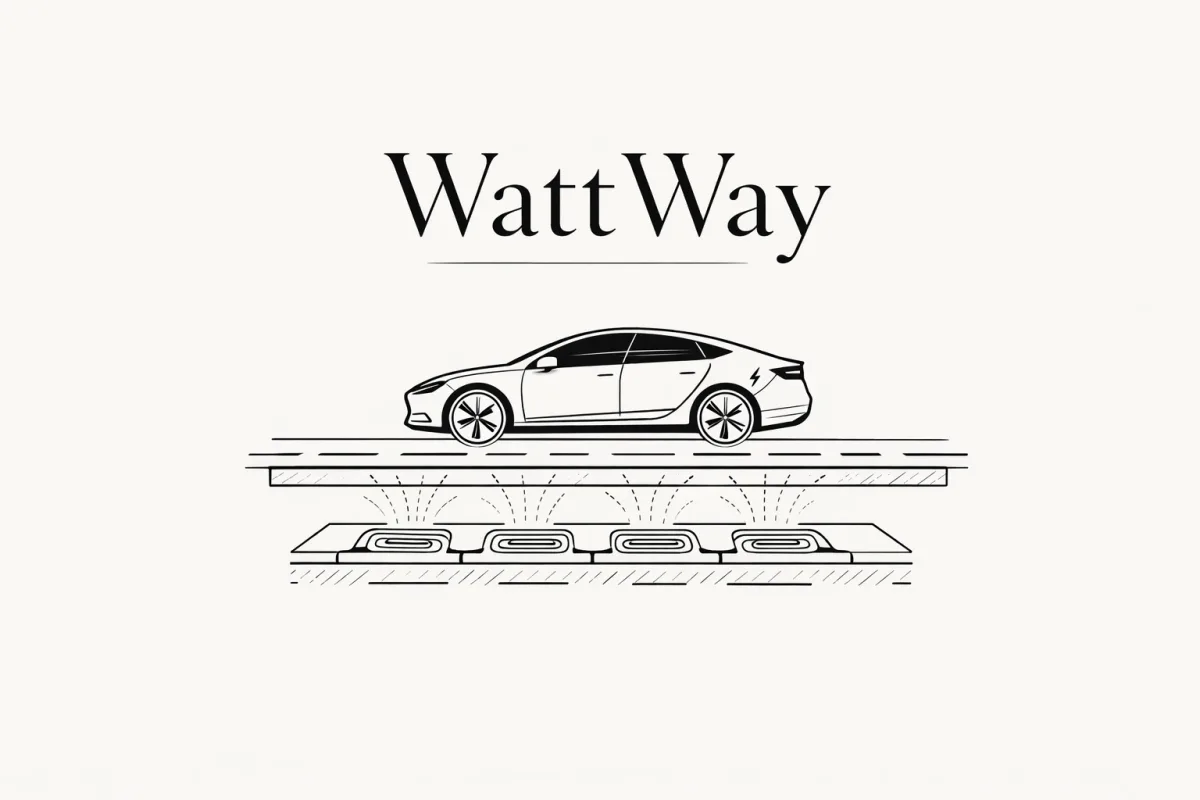
The core idea: transfer energy contactlessly from the road to an on-board receiver while the vehicle is moving.
Principle: inductive energy transfer
A 6-step approach
-
1
Measurement
Sensitivity to distance
First tests: increasing the distance between coils sharply reduces the recovered voltage (and therefore the available power). This calls for either a small gap or ways to improve coupling.
-
2
Measurement
Coil alignment
A lateral offset reduces the captured flux, and therefore performance. For an “inductive road”, this directly shapes the design: geometry, usable width, guidance.
-
3
Optimisation
Ferrite core
Ferrite channels the magnetic flux and clearly increases the voltage measured in the receiving coil, especially when the distance cannot be reduced further.
-
4
Optimisation
Resonant circuit (L + C)
Pairing the coil with a capacitor creates a gain peak around the resonant frequency. A frequency sweep identifies the optimal range.
-
5
Prototype
Test road
Building a road model to test reception dynamically (moving over the segment) and check signal stability and supply consistency.
-
6
Prototype
AC → DC rectification
Since the induced signal is alternating, a diode bridge converts it to direct current to power a charging system (with optional filtering afterwards).
What this project shows
- Performance depends heavily on distance and alignment.
- Ferrite + resonance significantly improve transfer efficiency.
- A road model validates the concept in near-real conditions.
- AC→DC rectification is essential for real charging.
Interested in this project?
I would be happy to talk about this project or an internship opportunity.